Rattan and Wicker Furniture Manufacturing in Vietnam
Woven furniture is one of those categories where quality is decided largely by hand, long before anyone sees the finished piece.
Rattan and wicker have moved well beyond the beach house. Today they show up in hotel lobbies, resort terraces, restaurants, retail collections, and residential interiors with no tropical theme at all. What has not changed is how the furniture is made: a woven chair still depends on the skill of someone who has spent years learning how to keep even tension across a frame.
This guide covers the practical things buyers should understand about rattan and wicker manufacturing in Vietnam: the materials and where each one works best, how woven furniture is actually built, which constructions suit which settings, and what should be settled before a wholesale or project order is placed. We produce these categories through our workshops in Nha Trang, Ho Chi Minh City, and the Binh Duong and Dong Nai provinces, so the perspective here comes from inside the production process.
Rattan, Wicker, and Synthetic Fiber: Three Different Things
These three terms are often used interchangeably in specifications and catalogues, but they describe different things. That distinction matters once an order reaches production.
Rattan is a material
Rattan is a climbing palm that grows through Southeast Asian forest canopies and is harvested as long, solid canes. Unlike bamboo, which is hollow, rattan has a solid core. That is what allows it to be steam-bent into curves while still carrying weight. Thicker poles become frames, the peeled outer skin becomes binding cane, and the inner core is split into strands for weaving.
Wicker is a technique
Wicker describes the weaving technique rather than a specific material. It can be made from rattan core, willow, seagrass, water hyacinth, paper cord, or synthetic fiber. Asking for "wicker furniture" without identifying the fiber leaves one of the most important parts of the specification open to interpretation.
All-weather synthetic fiber is the third category, and it should be treated as a purpose-built material rather than a lesser substitute for natural rattan. Extruded polyethylene strands are woven using many of the same techniques over powder-coated aluminium frames. Quality varies significantly, especially in UV stabilization, and the difference between a good fiber and a cheap one often becomes obvious after a few seasons rather than in the first year.
What to put on a specification
Specify the fiber, frame material and wall thickness, weave pattern, and finish system. A line item that says only "rattan chair, natural" leaves too many decisions to the factory, and different suppliers will make those decisions differently.
Choosing Material for the Setting
Most specification problems in this category come from using the right-looking piece in the wrong environment. The setting should drive the material choice, not the other way around.
Interiors and covered spaces
Natural rattan and wicker are at their best in interiors and protected spaces: lobbies, guest rooms, dining rooms, cafés, and shaded verandas. The grain and tonal variation of natural cane give these pieces a character that synthetic fiber can approximate but not fully reproduce.
Terraces, gardens, and poolside
For terraces, gardens, and poolside settings, all-weather synthetic fiber over aluminium is usually the better choice. Sustained UV exposure, rain, humidity swings, and chlorine will eventually break down natural cane regardless of how well it was finished. That is a material limitation, not a workmanship issue.
Coastal and beachfront
Coastal and beachfront environments are especially demanding. Synthetic fiber is usually the right choice, but the frame specification matters just as much. Powder-coated aluminium generally performs better in salt air, while coated steel tends to have a shorter service life close to the water.
Mixed indoor and outdoor programs
When a hospitality property needs the same visual language from the lobby to the pool deck, the practical solution is often one silhouette produced in two material systems: the same profile and proportions, but a different fiber and frame depending on the environment.
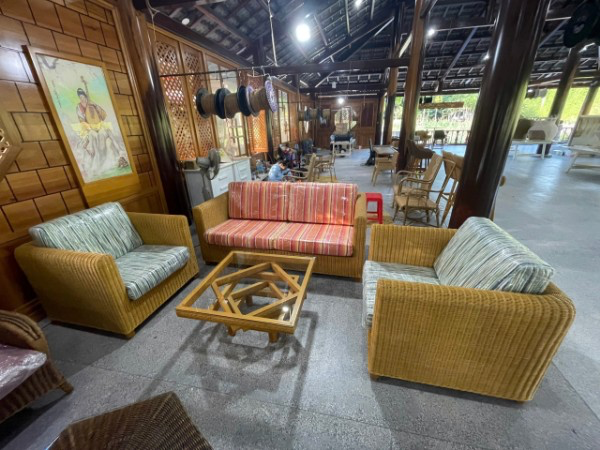
Natural rattan comes into its own indoors, where variation in tone and grain becomes part of the character of the piece rather than something to hide.
How a Woven Piece Is Built
Understanding the production sequence helps buyers ask better questions and also explains why lead times in this category work the way they do.
Material preparation
Cane is cleaned, graded, and dried before production begins. Moisture content at this stage has a major impact on whether the finished piece holds its shape after shipping. If rattan is rushed through drying, it can move later, showing up as loosened weave or split joints months after delivery, usually at the customer's end rather than the factory.
Frame construction and bending
Frame poles are softened with steam, formed around jigs, and held until the shape sets. For synthetic programs, aluminium tube is cut, welded, and powder-coated before weaving begins. Because the frame determines the silhouette, approving it at the sample stage can prevent a lot of rework later.
Weaving
This is the part of the process that cannot really be rushed. Strands are worked over the frame by hand, and keeping even tension across a seat or back panel is a skill built over years. Uneven weaving is obvious when you handle the piece in person but very easy to miss in a product photograph. That is one reason production samples matter so much.
Finishing
The finishing stage includes sealing, staining or lacquering, proper cure time between coats, and final inspection. Interior and exterior finishes are different systems and should be specified accordingly.
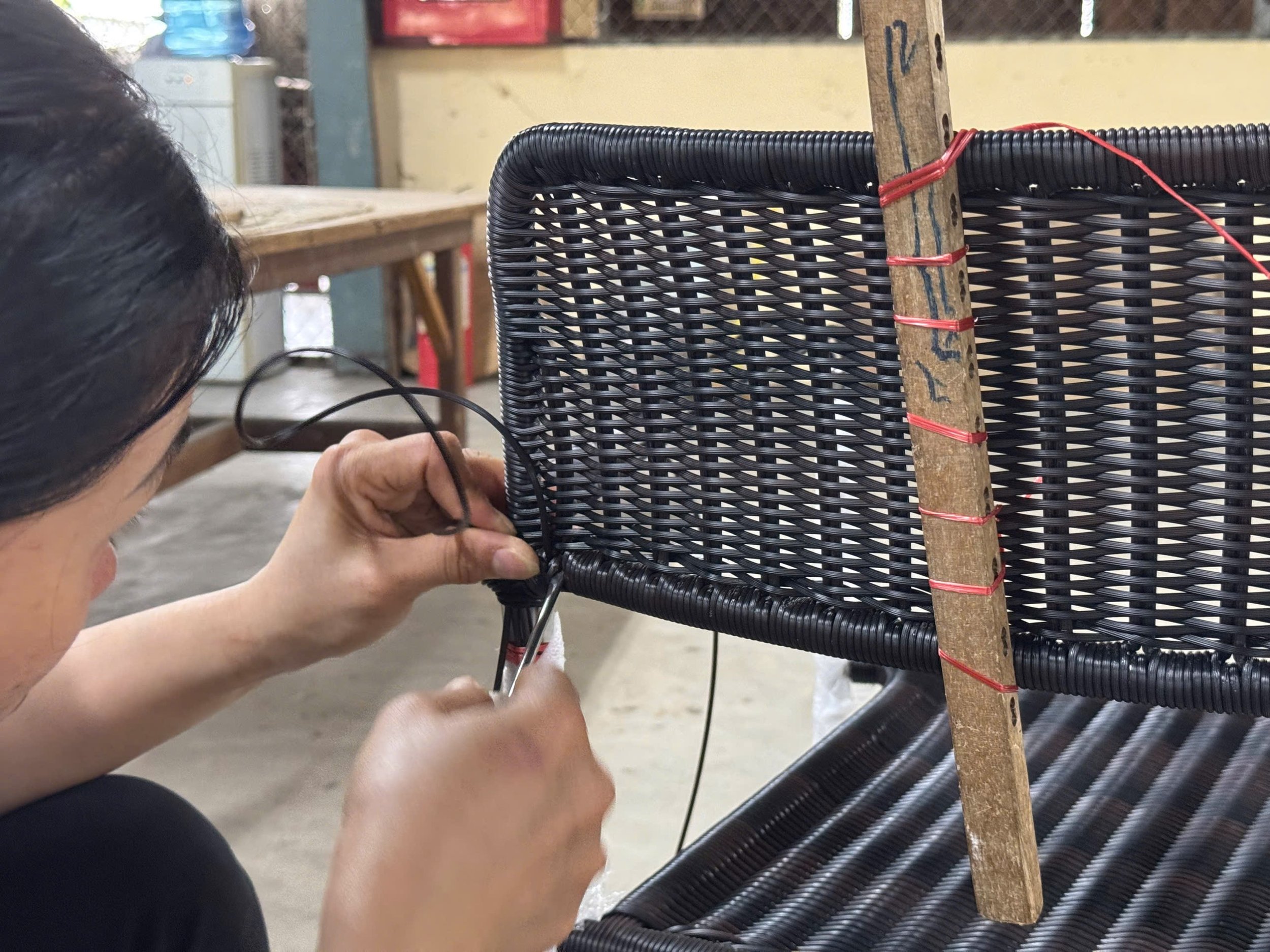
Weave tension is set by hand and is one of the clearest indicators of a workshop's overall standard.
Weave tension is easy to miss in a photograph and obvious when you handle the piece. Ask to see the production standard.
Where These Categories Are Specified
Hospitality
Hotels, resorts, restaurants, and cafés are some of the biggest users of woven furniture, and the performance requirements are demanding. Commercial seating takes far more abuse than residential furniture, and replacing pieces in the middle of a season can cost far more than whatever was saved on the original specification. Lobby seating, guest room chairs, terrace dining, poolside loungers, and daybeds can all work well when the material is matched to the setting.
Woven furniture also has a practical advantage in hospitality: it is relatively light. Reconfiguring a dining room for an event or clearing a terrace ahead of bad weather is much easier with woven seating than with heavy solid-wood pieces.
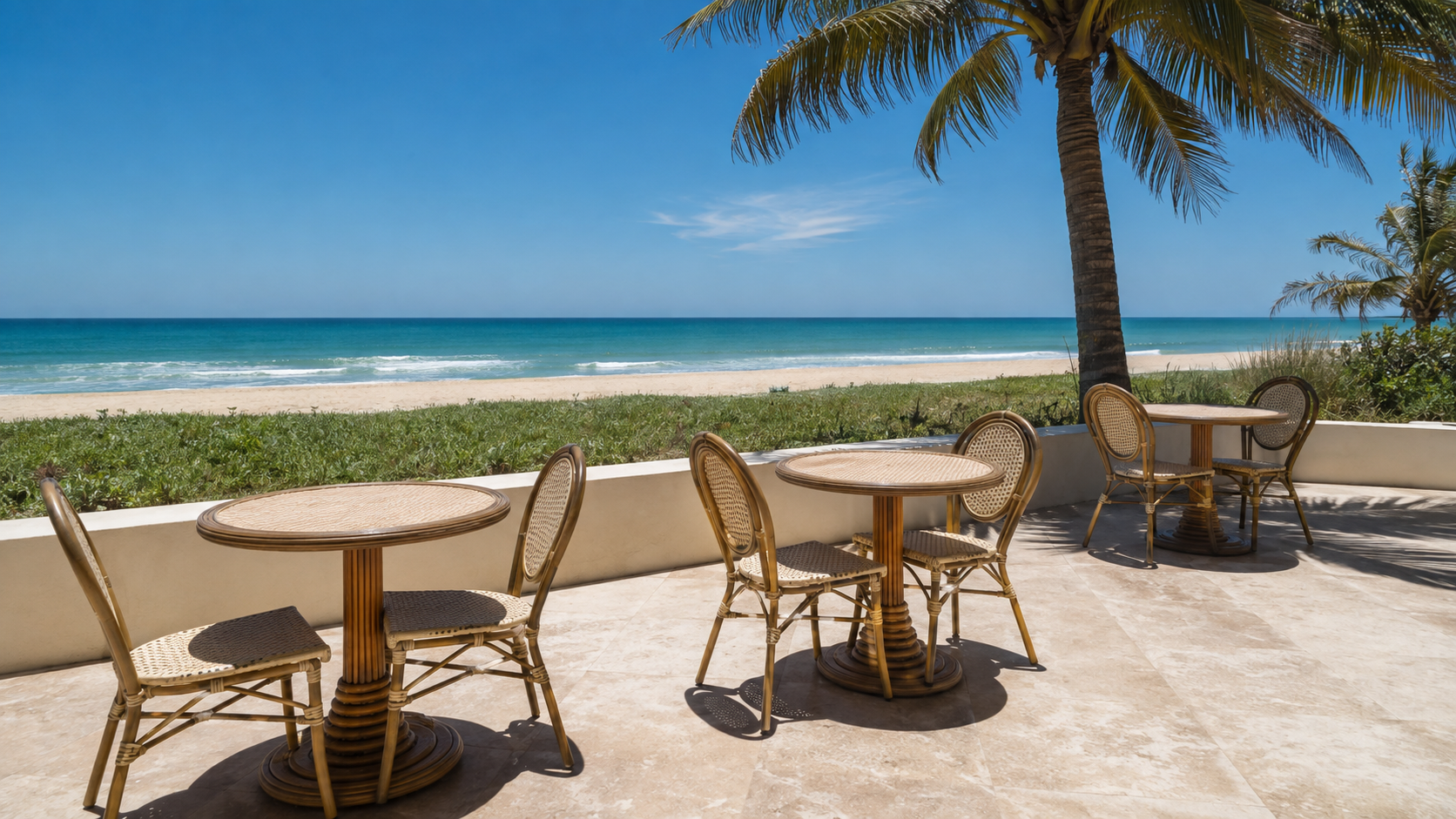
For café and terrace seating, light weight and easy reconfiguration can matter just as much as appearance.
Retail and brand programs
Retailers and furniture brands usually need more than a single product. They need consistent proportions across a collection, coordinated finishes, packaging that works for their distribution model, and the ability to repeat the program across seasons. That requires a different production discipline from one-off project work and should be planned that way from the start.
Interior design and residential projects
Designers often come to us with a drawing, a reference image, or an existing piece they want to adapt. Woven construction is well suited to that kind of development because a new silhouette can often be created without the mold and tooling costs associated with molded or cast products.
Custom, OEM, and Private Label Production
Handwork scales differently from tooling, which is one reason Vietnam works well for custom woven programs. Changing a dimension, weave pattern, or frame profile often means adjusting a jig and briefing the workshop rather than commissioning entirely new equipment.
In practice, this usually falls into three categories: adapting an existing profile to a project specification, developing a new piece from a drawing or sample, or producing an established design under a client's own brand. All three follow the same basic sequence of specification, sampling, approval, and production. The main difference is how much development work is needed up front.
We work directly through our own workshops, with no outside trading company or agent between the buyer and the people producing the order. That direct line matters most on custom programs, where specifications often evolve as samples are reviewed and production gets underway.
Practical Considerations Before You Order
There are four practical issues worth settling early, and every one of them is cheaper to solve before production begins.
Container efficiency. Woven furniture is often bulky relative to its weight, so landed cost per unit matters more than the FOB price alone. Knock-down construction, nesting, and carton dimensions can have a bigger impact on the final economics than another round of unit-price negotiation.
Sampling as its own phase. Custom and private label programs need a sampling window that is separate from bulk production. Trying to compress that stage is one of the easiest ways to end up with a product that is technically finished but not quite right.
Finish consistency across a program. Natural cane varies in tone by nature. Agreeing in advance on how much variation is acceptable, and documenting that standard, avoids unnecessary disagreement during inspection.
Replacement and continuity. Hospitality buyers should ask whether the same specification can still be produced a year or two later. For a property that will inevitably need replacement pieces, continuity can matter more than a small difference in the original unit price.
Buyers evaluating Vietnam as a sourcing origin more broadly may find our buyer's guide to sourcing furniture from Vietnam a useful companion to this piece.
Craft and Responsibility
Rattan is a renewable forest resource that grows quickly and, when harvested responsibly, can support the standing forest it grows through rather than requiring it to be cleared. That gives it a real environmental advantage over materials that depend on land conversion.
The people behind the furniture matter just as much as the material. Weaving skill in Vietnam is often passed through workshops and families over generations. We produce through facilities where we have direct visibility into working conditions and pay, which matters both ethically and practically. Consistent quality depends on experienced craftspeople, and experienced craftspeople stay where the work is treated as skilled work.
Rattan · Wicker · Synthetic Fiber
Tell Us What You're Building
Whether you are specifying a hospitality package, developing a private label collection, or deciding between natural cane and synthetic fiber, we are happy to talk through the program before anything is committed. Send us the project details and we can give you a clear recommendation on fit, materials, and production approach.
Start a Conversation