Sourcing Furniture from Vietnam: A Buyer's Guide for 2026
Vietnam has become a major furniture source for buyers in North America and Europe. For companies looking at the country for the first time, the same two questions usually come up: how good is the quality, and how do you find a factory you can actually trust?
Both deserve a straightforward answer. This guide looks at where Vietnamese furniture manufacturing is strongest, why quality can vary so much from one supplier to another, how to evaluate a factory before committing to a purchase order, and what buyers should expect around lead times, minimums, and landed cost. It is written for importers, retailers, hospitality groups, and designers with active sourcing programs.
At Pham Lifestyles, we manufacture rattan, wicker, bamboo, and all-weather synthetic fiber furniture in Vietnam, with production across Nha Trang, Ho Chi Minh City, Binh Duong, and Dong Nai. The guidance below reflects what the industry looks like from the factory side of the table.
Is Furniture Made in Vietnam Good Quality?
Yes. Vietnam is one of the world's largest furniture exporters, and its best factories produce woven, solid wood, and mixed-material furniture built for commercial use. Quality varies widely between suppliers, however. Material preparation, frame construction, weave technique, finishing, and inspection determine whether a piece holds up, so the factory predicts quality better than the country of origin.
Excellent furniture and furniture that struggles under moderate commercial use can come from the same country, and sometimes from the same province. The difference usually comes down to five fairly unglamorous production decisions:
- Material preparation. Properly cured and dried rattan holds its shape. Rattan that is rushed through drying can move, split, and loosen at the joints. The same principle applies to moisture content in solid wood, where poor drying is one of the most common causes of problems after shipping.
- Frame construction. A woven piece is only as strong as the frame underneath it. Mortise-and-tenon or doweled joinery will behave very differently over time from a frame that relies heavily on staples and adhesive.
- Weave tension and technique. Maintaining even tension across a seat or back panel is a skill that develops over years. It is obvious when you handle the piece in person, but very easy to miss in a supplier photograph.
- Finishing. The number of coats, cure time between coats, and whether the finish is designed for indoor or exterior exposure all affect how the piece ages.
- Inspection points. Quality control should happen throughout production, not only when the goods are being packed. If a problem is discovered at final inspection, the choices are usually a delayed shipment or a compromised one.
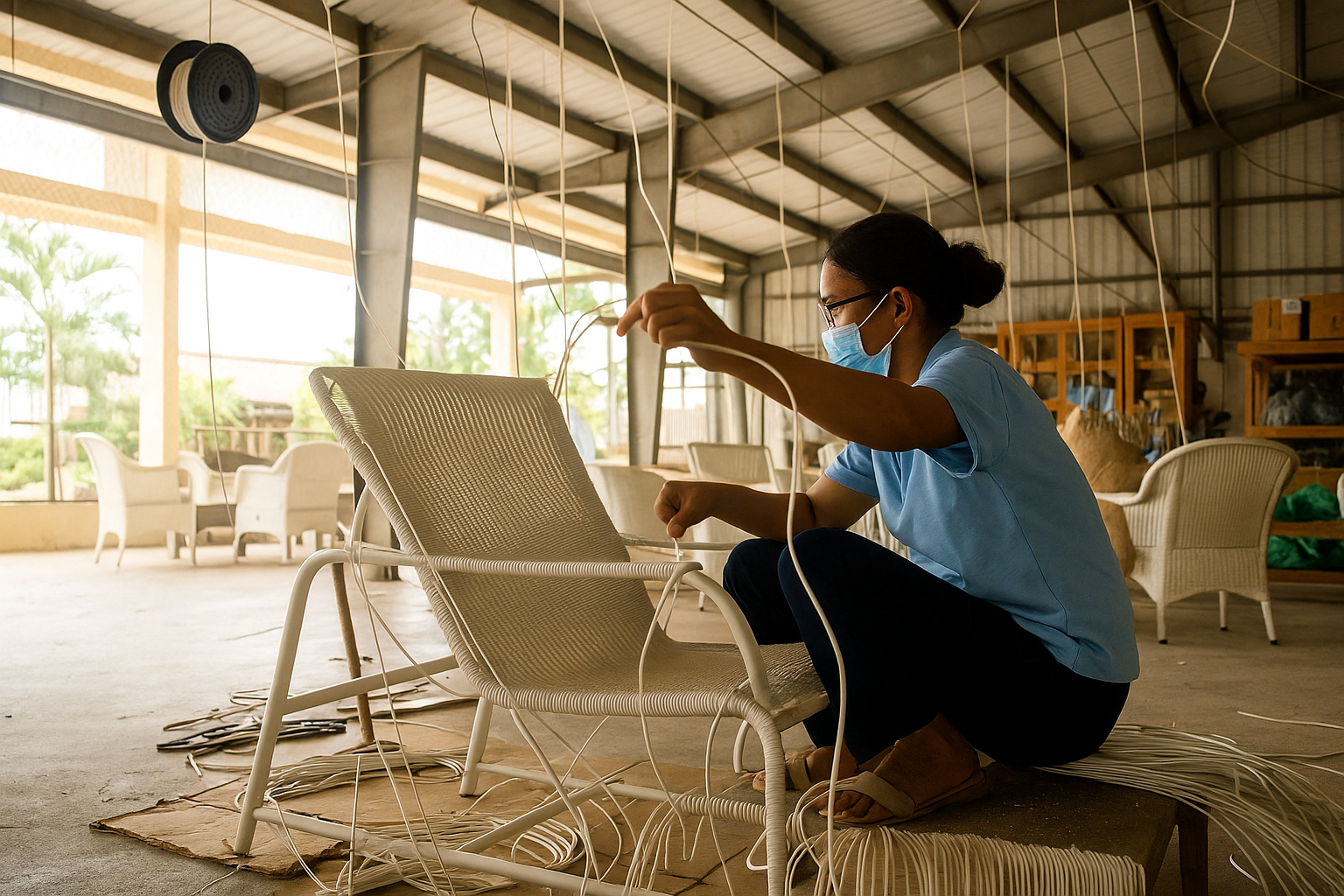
Weave tension is set by hand and refined through years of practice. It is one of the clearest indicators of a workshop's overall standard.
None of this is especially exotic. It is simply the discipline of a factory that expects to be making the same product years from now. When buyers have a poor experience sourcing furniture from Vietnam, the cause usually traces back to a supplier that skipped basic production controls, or to an intermediary with little visibility into the goods.
Where Vietnamese Manufacturing Is Strongest
Rattan, wicker, and all-weather synthetic fiber
Weaving in Vietnam is a long-established craft with roots that predate the export industry. In coastal and delta regions, rattan work has been passed down for generations, creating a deep skill base that supports both traditional forms and more contemporary design work.
For interiors, natural rattan and wicker bring warmth and a handmade quality that molded materials do not really replicate. Outdoors, all-weather synthetic fiber woven over powder-coated aluminium frames can create a similar look while standing up much better to UV exposure, humidity, chlorine, and salt air. The difference is most noticeable around pools, terraces, and other open-air hospitality spaces. Our comparison of synthetic fiber and natural rattan covers that choice in more detail.
Solid wood and mixed-material pieces
Vietnam also has a mature solid wood export industry, which is important for dining programs, casegoods, and larger hospitality packages. In practice, some of the most interesting products combine materials: woven seats and backs on wood or metal frames, or wood tops paired with woven bases. Producing those elements through one coordinated facility reduces the alignment problems that can arise when components are made in different places.
Custom, OEM, and private label production
Design flexibility is one of Vietnam's real strengths. Handwork scales differently from tooling, which makes it easier to develop a woven silhouette from a designer's drawing, an existing sample, or even a strong reference image without taking on the mold and setup costs required for many molded or cast products.
That makes Vietnam a practical sourcing origin for custom hospitality programs, private label collections, and OEM work where a retailer or brand wants something built to its own specification rather than selected from a catalogue.
A note on what "custom" should mean
Custom production should go well beyond changing the color of an existing frame. Material and finish specifications, dimensions, and construction details should all be documented before sampling begins. If those conversations are not happening, the product is not really being developed to your specification.
How to Evaluate a Vietnamese Furniture Supplier
Most sourcing problems can be traced back to decisions made before production ever starts. Six basic checks will eliminate a large share of them. For a more detailed walkthrough, see our guide to vetting a Vietnam furniture manufacturer.
Confirm who actually manufactures
Ask directly who will make the product and whether the company you are speaking with owns the production or places it elsewhere. Trading companies and agents can be useful, but they add another layer between the buyer and the workshop. You should know exactly which model you are dealing with before comparing prices.
Get the material specification in writing
Get the important details on paper: rattan grade and diameter, synthetic fiber type and gauge, frame material and wall thickness, finish system, and hardware. Without a written specification, a quotation is just a number. You do not yet know whether two suppliers are pricing the same product.
Request a production sample
A showroom sample may have been built by a senior craftsperson with far more time than a normal production piece receives. What you really want to understand is the standard that can be repeated across an order. When possible, ask to see a sample pulled from an actual production run.
Understand the inspection points
Ask where inspections happen, who performs them, and what happens when a piece fails. A supplier that can walk you through the process clearly usually has one. A vague answer often means most quality control is being left until final inspection.
Settle packing and container loading early
Woven furniture is often bulky relative to its weight, so container efficiency can affect landed cost almost as much as the unit price. Knock-down construction, nesting, and carton dimensions should be part of the discussion before the order is placed, not after production is complete.
Test the communication first
Pay attention to how the supplier communicates during quoting. Response time, clarity, and a willingness to push back on unrealistic requests are usually a good preview of how the relationship will work once production starts. Communication rarely gets better after a deposit has been paid.

All-weather synthetic fiber over a powder-coated aluminium frame, specified for ongoing exposure to UV, humidity, and chlorine.
Lead Times, Minimums, and Sampling
Handwoven furniture moves on a different timeline from machine-made goods, and buyers coming from other product categories can underestimate how much time the process requires.
Sampling should be treated as its own phase, particularly for custom or private label work where dimensions, materials, or finishes are still being finalized. Once the sample is approved, production time depends on quantity, material availability, and finish complexity. Ocean freight to North America or Europe comes after that, so buyers need to plan around the full timeline rather than the factory lead time alone.
Minimum order quantities vary widely and are often driven by the individual product rather than one fixed rule across an entire factory. If a supplier gives the same minimum for every item in its range, it is worth asking what is actually driving that number.
The practical lesson is simple: start earlier than seems necessary. This is especially important for hospitality projects with a fixed opening date, where a compressed schedule creates the most risk and expediting is usually the most expensive. Our hospitality FF&E procurement framework covers how to structure an RFQ so that timelines and quotes can be compared on equal terms.
Landed Cost and Trade Considerations
Unit price is only one part of the sourcing decision. The number that really determines whether a program works is landed cost: product cost, duty, freight, insurance, and the container efficiency that determines how many units share the ocean charge.
Duty depends on tariff classification, and classification depends on material composition and construction. Two products that look very similar can therefore carry different duty rates. Trade policy affecting Vietnamese goods has also changed considerably in recent years, so buyers planning a multi-season program should verify the tariff position at the time of each order rather than assume it is fixed.
We cover this in more detail in our guide to importing furniture from Vietnam.
Direct Factory or Intermediary?
Both approaches can work. The better choice depends on how much sourcing capability you already have in-house and how directly you want to manage production.
Working with a factory directly
You have fewer layers in the chain, more direct access to the people making the product, and usually faster resolution when a specification changes. The tradeoff is that the buyer needs to be more involved, so this model works best when you know what you want built and have the ability to manage the details.
Working through an agent
An agent can be useful when you are sourcing across many categories, consolidating shipments from several suppliers or origins, or simply do not have the internal capacity to manage each factory relationship. You give up some direct visibility and pay for that layer of service, which can be a perfectly reasonable tradeoff for the right buyer.
Our own model is direct, with no outside intermediary between the buyer and the workshop. It is a deliberate choice, and it will not suit every buyer. It is a good fit for clients who want to specify products closely and stay connected to the people producing the order.
Country of origin only tells you so much. The factory tells you far more.
What This Means for Buyers
Vietnam has earned its place in the global furniture industry through real manufacturing capability and a deep base of skilled craftspeople. It is especially strong in handwoven and mixed-material furniture, and it is a good fit for custom, OEM, and private label programs where design flexibility carries as much weight as scale.
What Vietnam does not give you is a guarantee. Buyers still need to choose the factory carefully, put specifications in writing, understand how production quality will be checked, and work through packing before the order is placed. Do that well and Vietnam can be an excellent sourcing origin. Skip those steps and the country of origin will not protect you.
Sourcing · Direct From Factory
Let's Talk About Your Program
Whether you are specifying a hospitality package, developing a private label collection, or considering Vietnam as a sourcing origin for the first time, we are happy to talk through the program before anything is committed. Share what you are building, the quantities you are considering, and where the furniture will be used, and we can tell you whether our production network is the right fit.
Start a Conversation