Handcrafted Vietnamese Furniture: Tradition and Sustainability
"Handcrafted" is used so loosely in furniture that the word has started to lose its meaning. In Vietnam, though, it still describes a very real production process.
The term gets applied to everything from machine-built products with a hand-applied finish to pieces designed simply to look irregular. That makes it harder for buyers to understand what they are actually getting. In woven furniture, the difference between real handwork and a machine-led process is not just visual. It affects how the piece performs years after delivery.
This guide looks at what handwork actually means in production, why the tradition remains strong in Vietnam, what can reasonably be said about sustainability, and how buyers can evaluate a supplier's claims around both craft and responsibility.
What Handcrafted Means in Practice
There are four stages where handwork directly shapes the finished piece, and each one has a practical effect on quality.
Material preparation
Rattan arrives at the workshop as long, solid canes cut from a climbing palm. Before anything is built, the cane is cleaned, graded, and dried. Grading relies on experience: diameter, straightness, node spacing, and surface condition all help determine where a particular cane should be used. Thicker poles become frames, the peeled outer skin is used for binding, and the inner core can be split into strands for weaving.
Drying is one of the least visible stages, but it has an outsized effect on everything that follows. Cane dried to the right moisture level is far more likely to hold its shape. Cane rushed through the process can continue moving after it leaves the workshop, which may show up months later as loosened weaving or separated joints. By then, the furniture is usually already with the buyer, and no final packing inspection would have caught the underlying problem.
Shaping and joinery
Rattan is solid rather than hollow, which allows it to be softened with steam, bent around a jig, and then hold both the curve and the load once it sets. Bamboo behaves differently because of its hollow structure. On a woven chair, those curves are created by someone applying heat and pressure to the cane and holding it in position until the shape is fixed.
Joinery comes next. Doweled and pegged construction will generally age differently from a frame that relies heavily on staples and adhesive. The challenge for buyers is that both can look nearly identical when new, especially in photographs.
The weave
This is the stage where the skill of the craftsperson is most obvious. As the weave moves across a three-dimensional frame, tension has to be adjusted constantly, and the natural variation in each strand has to be managed as the work progresses. Keeping that tension consistent is what helps a seat or back panel stay flat and supportive under use.
That skill takes years to develop. A weaver who has worked the same pattern for a decade will usually produce a level of consistency that a newer craftsperson cannot yet match. The difference is easy to see and feel in person, but much harder to judge from a photograph. That is one reason production samples matter so much in this category.
Finishing
Finishing includes sealing, staining or lacquering, along with the cure time between coats. Interior and exterior finishes are different systems and should be specified accordingly. Using the wrong one for the environment is a common mistake and an expensive one to correct later.
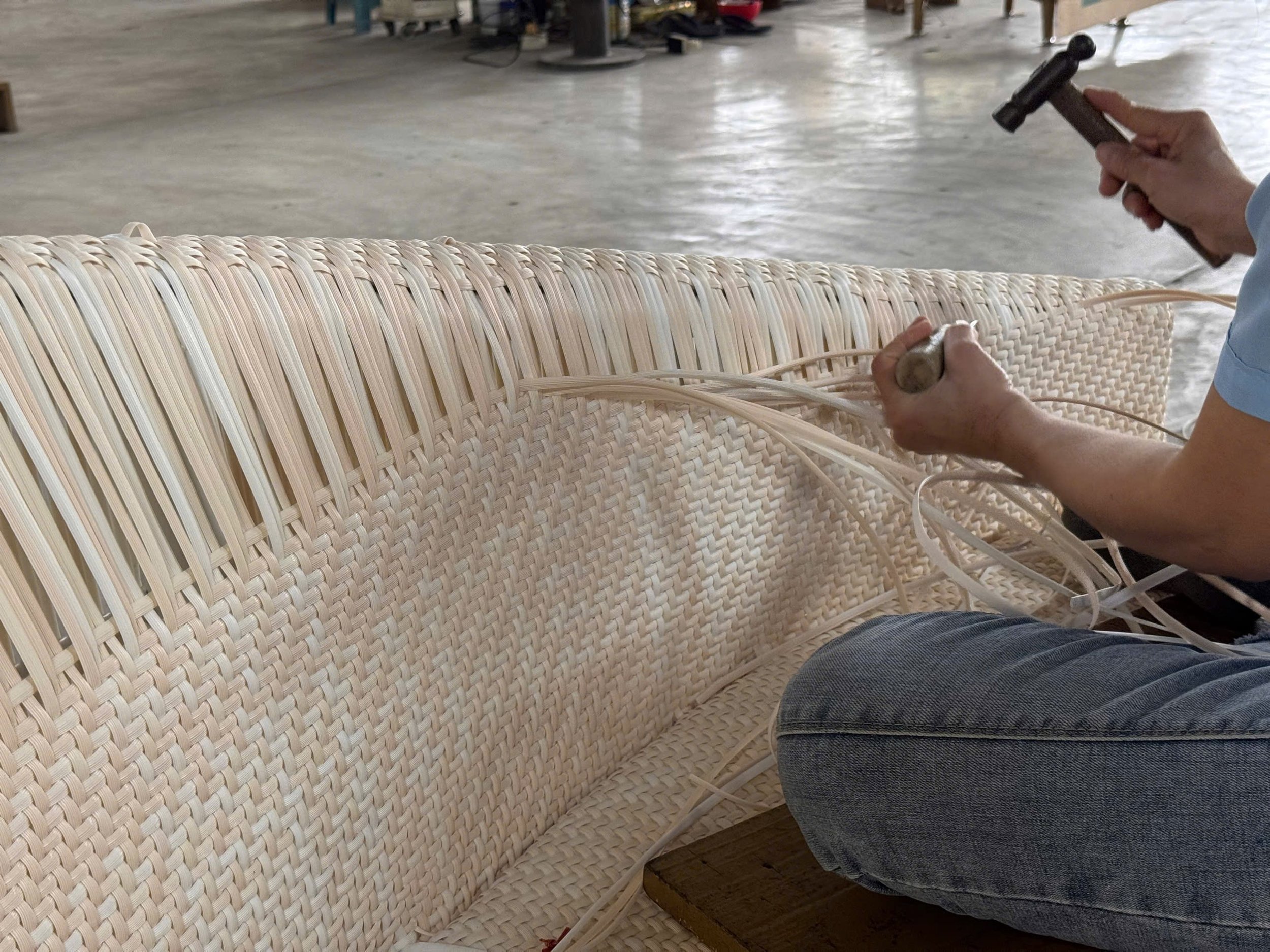
Weave tension is adjusted continuously by hand as the pattern moves across the frame.
Why the Tradition Persists Here
Handweaving has declined in many furniture-producing countries as manufacturing became more automated and tooling became the more economical route. Vietnam followed a different path, and understanding why helps explain what buyers are actually paying for when they source woven furniture here.
One reason is simple: the material is native to the region. Rattan grows across Southeast Asia, and workshops developed close to the places where the cane was harvested. That proximity allowed the craft to continue as a working tradition rather than something that had to be revived later.
The knowledge also moved through workshops and families rather than formal institutions. Weaving patterns, cane grading, and bending techniques are learned by working alongside someone with more experience. That kind of knowledge only survives when there is enough ongoing demand for people to keep practicing it, and export markets helped provide that continuity.
Just as important, the work has remained skilled. In some industries, handwork survives mostly as a marketing idea while production is divided into simple repetitive tasks. Woven furniture is harder to reduce that way because judgment and execution happen at the same time.
A weaver who has worked the same pattern for years develops a consistency that takes time to learn.
The Sustainability Case, Without the Exaggeration
Rattan does have real environmental advantages, and they are more credible when stated plainly than when overstated.
Rattan is a climbing palm that grows through existing forest canopy, using standing trees for support. It matures much faster than timber and can regenerate after harvesting. Because the plant can be collected without clearing the surrounding forest, it gives standing forest an economic value that does not depend on cutting the trees themselves.
Woven furniture is also relatively light for its size, and good knock-down construction can improve shipping efficiency further. Freight is a real part of a product's footprint, and packing decisions are one of the areas where buyers and manufacturers can actually make a measurable difference.
What we will not do is attach numbers to these claims unless we can support them. There are plenty of statistics circulating about furniture emissions and the size of the sustainable furniture market that are difficult to verify. A supplier willing to repeat numbers it cannot source is also telling you something about how carefully it handles other claims.
How to Evaluate a Sustainability Claim
Buyers with a serious sustainability requirement need a way to separate suppliers who have built it into their operations from suppliers who have simply written good marketing around it. Four questions can reveal a lot.
Decide what you actually mean
Renewable materials, labor practices, finishing systems, and freight efficiency are separate issues. A supplier may be strong in one area and much weaker in another. Decide which priorities matter most to your program before evaluating suppliers, or the conversation will naturally drift toward whichever area they are best prepared to discuss.
Ask what can be documented
Certification is one form of evidence, but it is not the only one. Ask what the supplier can actually show you: chain-of-custody records, facility information, inspection reports, or a site visit. A supplier with direct control over production should be able to show you how and where the work is being done.
Ask about labor specifically
"Fair wages and safe conditions" only mean something if the supplier can explain how they are managed in practice. Ask who employs the people making your order, how working conditions are overseen, and whether the facility can be visited. The answers to those questions are usually more useful than a broad statement on a website.
Look at packing and freight
Container efficiency, knock-down construction, and packaging materials affect both landed cost and environmental impact. It is one of the clearest areas where the commercial and sustainability cases point in the same direction, yet it is still often discussed too late in the process.
One question worth asking every supplier
"Who physically makes this, and can I see where?" The answer tells you a great deal about how much visibility the supplier really has into production. A direct manufacturer should be able to answer clearly.
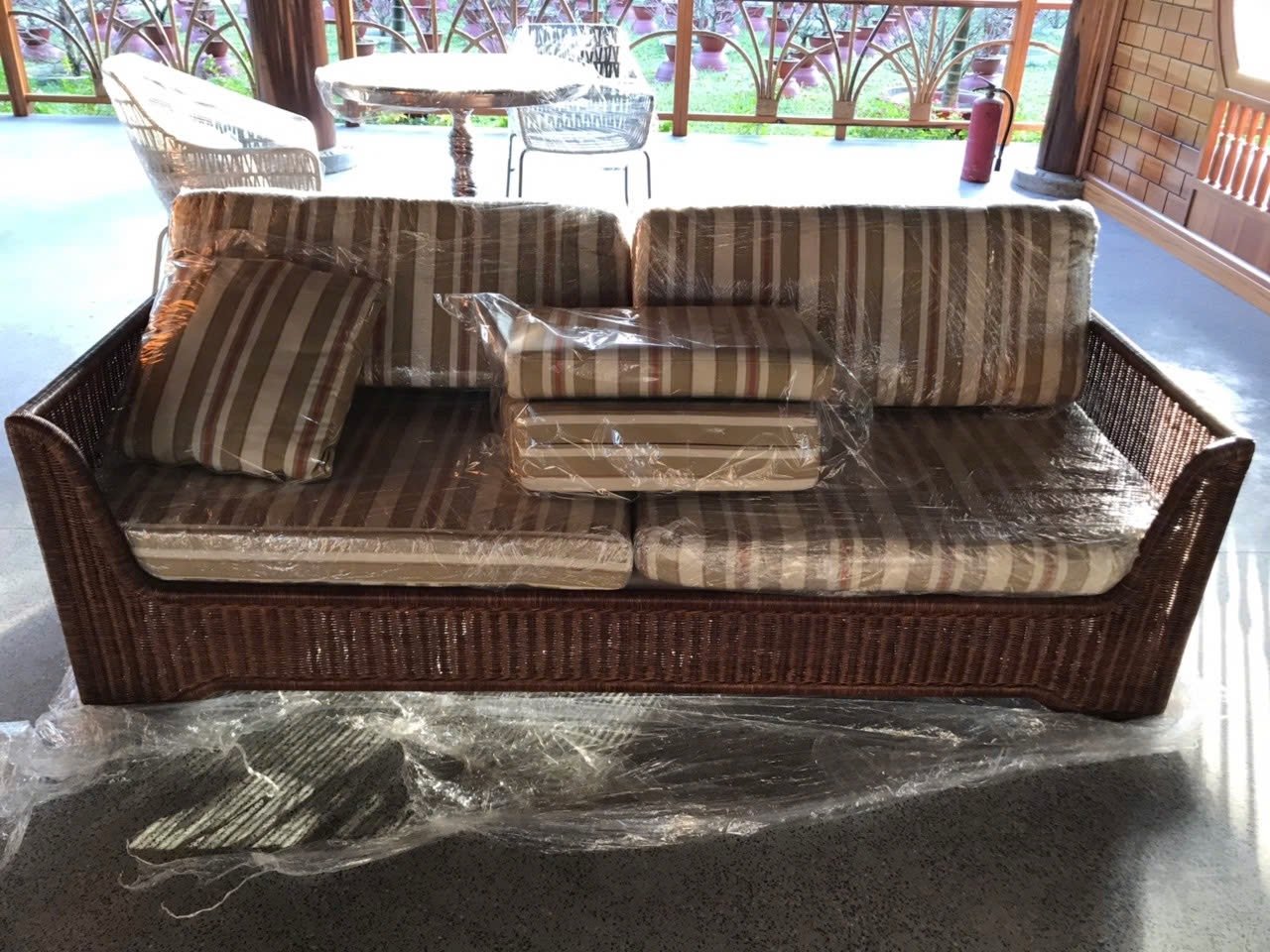
A finished piece in our Nha Trang workshop, photographed before packing.
What Handcraft Does Not Solve
The limitations matter just as much as the benefits, and there are three buyers should understand before specifying the material.
- Natural cane is primarily an interior material. Sustained UV, rain, and chlorine will eventually degrade it regardless of finish quality. Terraces, pool decks, and gardens are better suited to all-weather synthetic fiber over powder-coated aluminium. That is a limitation of the material itself, not a reflection of workmanship.
- Tonal variation is inherent. Natural cane varies in color both along a single length and from one cane to another. In a boutique setting, that variation often reads as character. Across a large hospitality program, though, acceptable variation should be documented before production so it does not become a disagreement during inspection.
- Handwork has practical limits on speed. Weaving takes time, and there is only so far the process can be compressed without affecting quality. Sampling is often the first stage buyers try to shorten, even though it is one of the most important to protect.
How We Work
We manufacture through our own workshop network in Nha Trang, Ho Chi Minh City, Binh Duong, and Dong Nai. There is no outside trading company or agent between the buyer and the people making the order, which gives us direct visibility into production and allows clients to visit the facilities themselves.
That direct model matters both ethically and commercially. Skilled weaving takes years to learn, and consistent production depends on experienced craftspeople staying in the work. In that sense, workforce stability and product quality are closely connected.
Buyers working through the wider sourcing decision may find our guide to sourcing furniture from Vietnam useful, and our guide to rattan and wicker manufacturing goes further into the material distinctions.
Craft · Sustainability
Come and See the Workshop
If you are specifying handwoven furniture for a project or developing a collection, we are happy to talk through the program, answer the difficult questions, and show you what we can document from the production side. Tell us what you are working on and we can give you a clear view of fit, materials, and approach.
Start a Conversation