Shipping Furniture from Vietnam: Duties, Incoterms, and Landed Cost Planning for the US, EU, and Australia
The headline tariff rate gets the most attention, but it rarely determines whether an import program works in practice.
Buyers importing furniture from Vietnam have spent the last two years watching duty rates change, face legal challenges, get replaced, and change again. That volatility has left a good deal of published guidance outdated, even when the numbers still appear with confidence.
This guide takes a practical approach. Each market section includes a review date because the policy-specific details will shift over time. The rest of the article focuses on mechanics that remain useful regardless of the current tariff environment: how duty stacks are built, why classification matters as much as country of origin, how shipping terms allocate cost and risk, and how ordering and packing decisions affect landed cost.
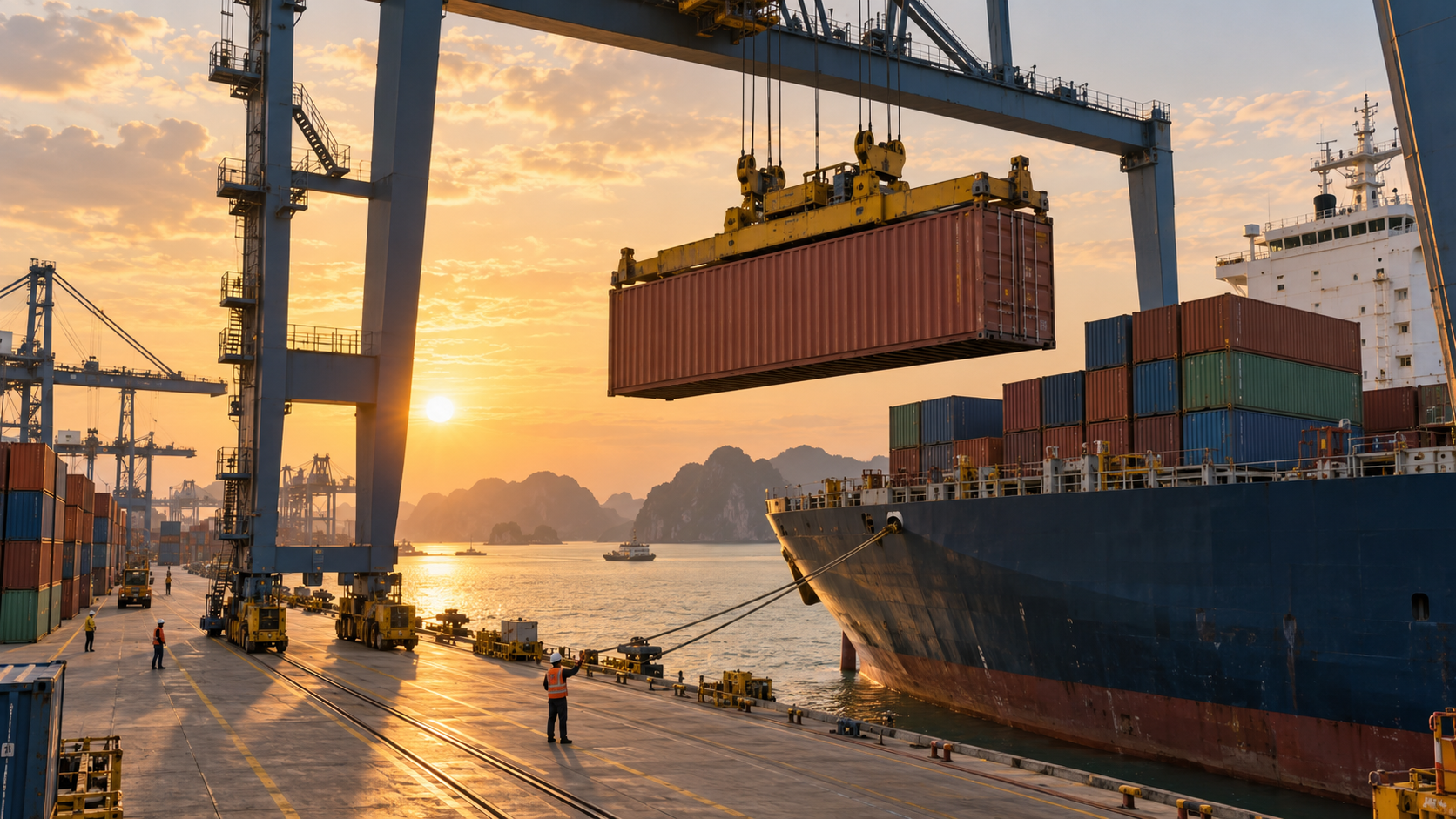
Vietnam is one of the world's largest furniture exporters, but what a shipment actually costs at the destination depends on the duty stack, shipping terms, and container efficiency.
Where Things Stand: United States
Reviewed September 2026. Trade policy affecting Vietnam has changed repeatedly over the past two years. Confirm current rates with your customs broker before quoting anything.
The emergency tariff regime that dominated 2025 is no longer in effect. It has been replaced by narrower trade authorities that are likely to prove more durable, though durability remains relative in this trade environment.
The 46% reciprocal tariff imposed on Vietnamese goods in April 2025 was struck down by the Supreme Court in February 2026 along with the rest of the IEEPA-based tariff program. It was replaced by a flat 10% surcharge under Section 122 of the Trade Act. By statute, that measure could remain in place for no more than 150 days, and it expired on July 24, 2026.
A Section 301 action took effect the same day Section 122 expired, with no gap in between. This action applies duties of 10% or 12.5% across roughly 60 economies. Vietnam falls into the higher 12.5% tier. The legal basis is a set of investigations into whether trading partners have enacted and enforced prohibitions on imports produced with forced labor. Unlike Section 122, Section 301 has no automatic expiration date, so the duty remains in place until USTR modifies it or the courts intervene.
Three additional points are worth tracking. Importers who paid the 46% IEEPA rate between April 2025 and February 2026 may be eligible for refunds, and a claims process has been open since April 2026. Products already subject to Section 232 duties (covered below) are generally excluded from the Section 301 forced-labor tariff, though the exemption is classification-specific and should be verified at the HTS code level. A separate Section 301 investigation into industrial overcapacity has not resulted in additional duties as of this writing.
How the US Duty Stack Is Built
Understanding the stack is more useful than memorizing a single rate. The percentages will change, but the structure is far more consistent. Duty on an imported furniture shipment can include several separate layers, each calculated against the customs value.
- The MFN base rate. This is the standard duty attached to the product's tariff classification. Most furniture covered by HTS Chapter 94 carries a base rate of zero, which has historically made imported furniture price-competitive even before any trade preference is applied.
- Section 301 (forced-labor tariff). At 12.5% for Vietnam, this is currently the most significant layer for most Vietnamese furniture imports. It applies broadly across product categories, with exemptions listed by HTS code in the Federal Register annex.
- Section 232 (wood products). This layer applies to specific product categories regardless of country of origin. In furniture, it covers upholstered seats with wooden frames (HTS 9401.61 subheadings), kitchen cabinets, and vanities at 25%. A rate increase to 30% for upholstered furniture and 50% for cabinets was delayed until January 1, 2027 by a December 31, 2025 proclamation. The UK, EU, and Japan receive a reduced 15% rate on the upholstered furniture categories.
Classification becomes especially relevant for woven furniture buyers at this point. Rattan seating (HTS 9401.53) and bamboo seating (HTS 9401.52) are classified separately from upholstered wooden seating and are not covered by the Section 232 wood action. The distinction is based on the product's construction and primary material, not on appearance or showroom placement. A woven rattan chair and an upholstered wooden chair can carry very different duty exposure even if they occupy the same space in a hotel lobby.
- Anti-dumping and countervailing duties. These are specific to the product and country of origin, can be substantial, and are easy to overlook because they often sit outside the headline tariff discussion. Wooden bedroom furniture from Vietnam has been subject to AD investigation. Woven rattan and bamboo furniture has not been subject to the same actions, but AD/CVD exposure should always be confirmed with your broker for any specific product classification.
- Fees. The Merchandise Processing Fee and Harbor Maintenance Fee are small compared with the major duty layers, but they belong in every landed cost model.
These layers generally stack rather than replace one another, with some exceptions where one trade action specifically excludes goods covered by another. A landed cost model should show each layer separately instead of relying on a single blended percentage.
Classification Decides More Than Origin
Product-level duties are written against specific tariff headings, not against the broad category of "furniture." The Section 232 wood action applies to upholstered seats with wooden frames under a defined set of HTS subheadings. A chair with a woven rattan seat classifies differently from an upholstered wooden chair, even if the two are specified for the same project and priced within dollars of each other.
The practical result is that two similar products from the same country can carry very different duty exposure depending on how they are built and what materials they use. That structure is how the tariff schedule operates, and it means a construction decision made during the design stage can also become a duty decision.
What to do with this
Have your customs broker classify the actual SKUs before you finalize the cost model, and do it early enough that the classification can still inform the specification. We provide the material composition, frame construction, and packing details your broker needs to complete that work.
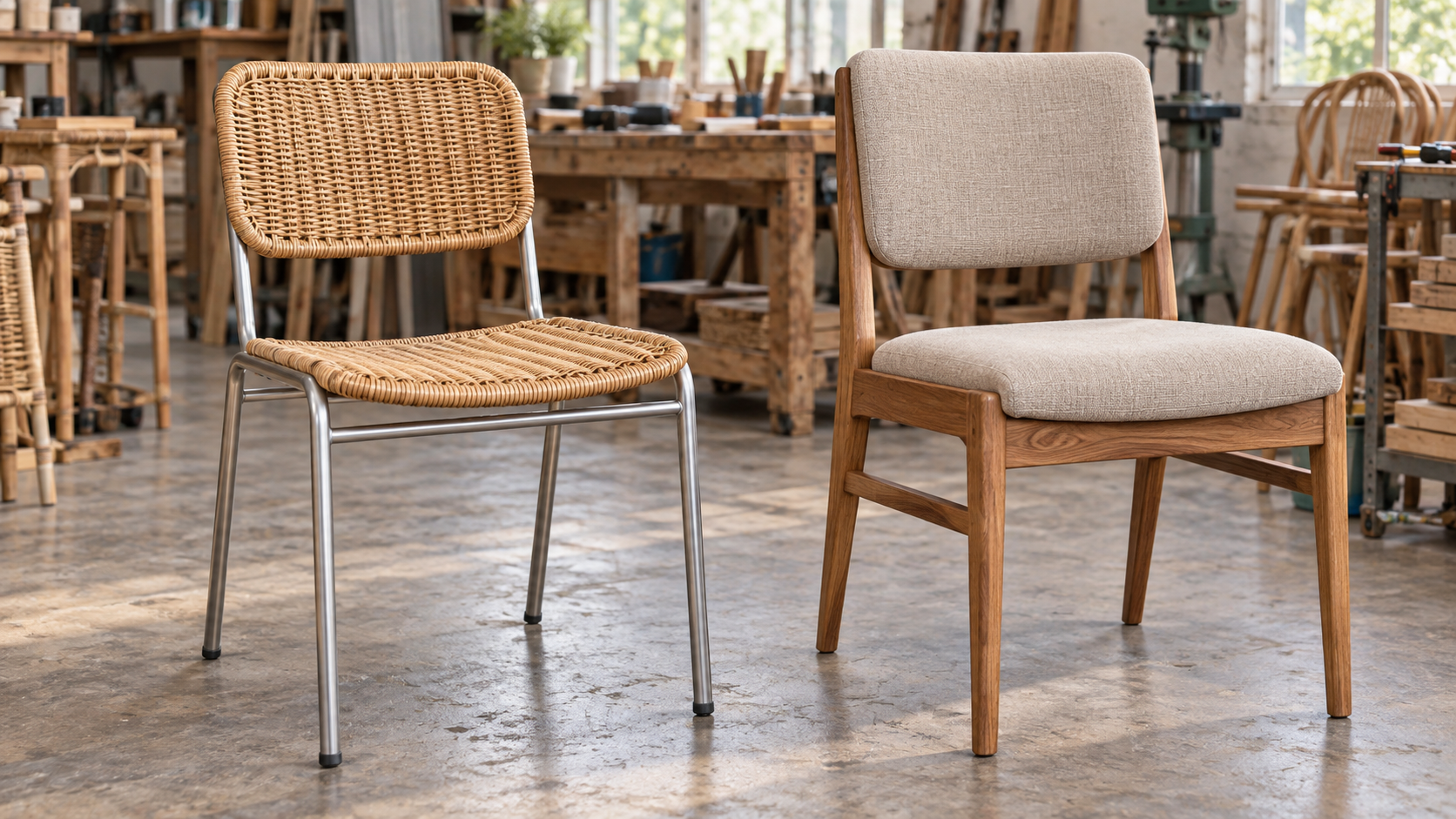
Different construction and material composition can place two visually similar chairs in different tariff classifications, with meaningfully different duty exposure.
Importing to the EU: EVFTA and Preferential Access
Reviewed September 2026.
The EU-Vietnam Free Trade Agreement (EVFTA) entered into force on August 1, 2020. It eliminated tariffs on 83% of wood product tariff lines immediately and completed the phase-out of the remaining lines by 2025. In practice, Vietnamese furniture now enters the EU at 0% duty under EVFTA for most Chapter 94 classifications.
To qualify for the preferential rate, shipments must meet two requirements. The goods must satisfy the EVFTA rules of origin, meaning the product must be genuinely manufactured in Vietnam, not transshipped through Vietnam from another origin. And each shipment must be accompanied by the appropriate documentation: either a Certificate of Origin (EUR.1) issued by the Vietnam Chamber of Commerce and Industry, or a self-certification statement under the REX (Registered Exporter) system for shipments above €6,000.
Without valid origin documentation, the standard MFN duty applies. For most furniture under Chapter 94, the MFN rate is 2.7% to 5.6%, which is low but not zero, and worth claiming against across a large program.
EU buyers should also be aware of the EU Deforestation Regulation (EUDR), which requires due diligence on products containing wood or wood-derived materials to verify they are not linked to deforestation. While this regulation is most directly relevant to timber furniture, buyers specifying bamboo or sourcing from factories that also handle wood products should understand their due diligence obligations. Enforcement timelines have been adjusted and should be confirmed for the current year.
VAT is a separate consideration. Each EU member state applies its own rate (typically 19% to 25%) on the CIF value plus any duty. VAT is generally recoverable for registered businesses but must be accounted for in cash flow planning.
Importing to Australia: AANZFTA and CPTPP
Reviewed September 2026.
Australia's standard MFN duty rate on most furniture (Chapter 94) is 5% of the customs value. However, Vietnamese furniture qualifies for preferential access under two overlapping agreements: AANZFTA (the ASEAN-Australia-New Zealand Free Trade Area, in force since 2010) and CPTPP (the Comprehensive and Progressive Agreement for Trans-Pacific Partnership). Under either agreement, most furniture classifications enter at 0% duty.
Which agreement delivers the better rate depends on the specific HS code and which rule of origin the product can meet. In most cases, the result is the same (duty-free entry), but the documentation requirements differ. AANZFTA requires a Certificate of Origin proving the goods were produced in an ASEAN member state. CPTPP has its own origin certification process. The Australian Government's Free Trade Agreement Portal allows importers to compare preferential rates by product code across all active agreements.
Without a valid Certificate of Origin, the full 5% MFN rate applies regardless of where the goods were actually manufactured.
GST of 10% applies on top of the landed value (customs value plus freight, insurance, and any duty). For businesses registered for GST, this is generally claimable as an input tax credit.
Australian biosecurity requirements are worth flagging separately. Solid wood packaging (pallets, crates, dunnage) must comply with ISPM-15 treatment and marking standards. Noncompliant packaging can result in treatment at the border, delays, or re-export, any of which add cost. Confirm with your freight forwarder that packing materials meet the standard before the container is loaded.
Incoterms: Who Pays for What, and When Risk Transfers
Incoterms define where the seller's responsibility ends and the buyer's begins. In furniture sourcing from Vietnam, three terms come up most often, and the choice between them affects more than just the freight line on the invoice.
EXW (Ex Works)
The buyer takes responsibility at the factory gate. The buyer arranges pickup, inland transport to the port, export customs, ocean freight, and everything after. EXW gives the buyer maximum control over logistics but also maximum responsibility. It is uncommon for international furniture orders unless the buyer has an established freight operation in Vietnam.
FOB (Free on Board)
The seller handles production, inland transport, export customs clearance, and loading onto the vessel at the port of origin. The buyer assumes cost and risk once the goods are on board. FOB is the most common term for furniture exports from Vietnam, and it is how we quote.
CIF (Cost, Insurance, Freight)
The seller arranges and pays for ocean freight and marine insurance in addition to everything covered under FOB. Risk still transfers to the buyer at the origin port, which means the buyer bears the risk during transit even though the seller arranged the freight.
The incoterm should be agreed before the first quote is issued, not after. It determines which costs appear in the unit price and which sit in the buyer's logistics budget. Mixing those assumptions can make a program look profitable on paper until the freight invoice arrives.
For buyers comparing quotes from multiple suppliers, make sure all quotes use the same incoterm. An FOB quote from one supplier and a CIF quote from another are not directly comparable without adjusting for the freight and insurance embedded in the CIF price.
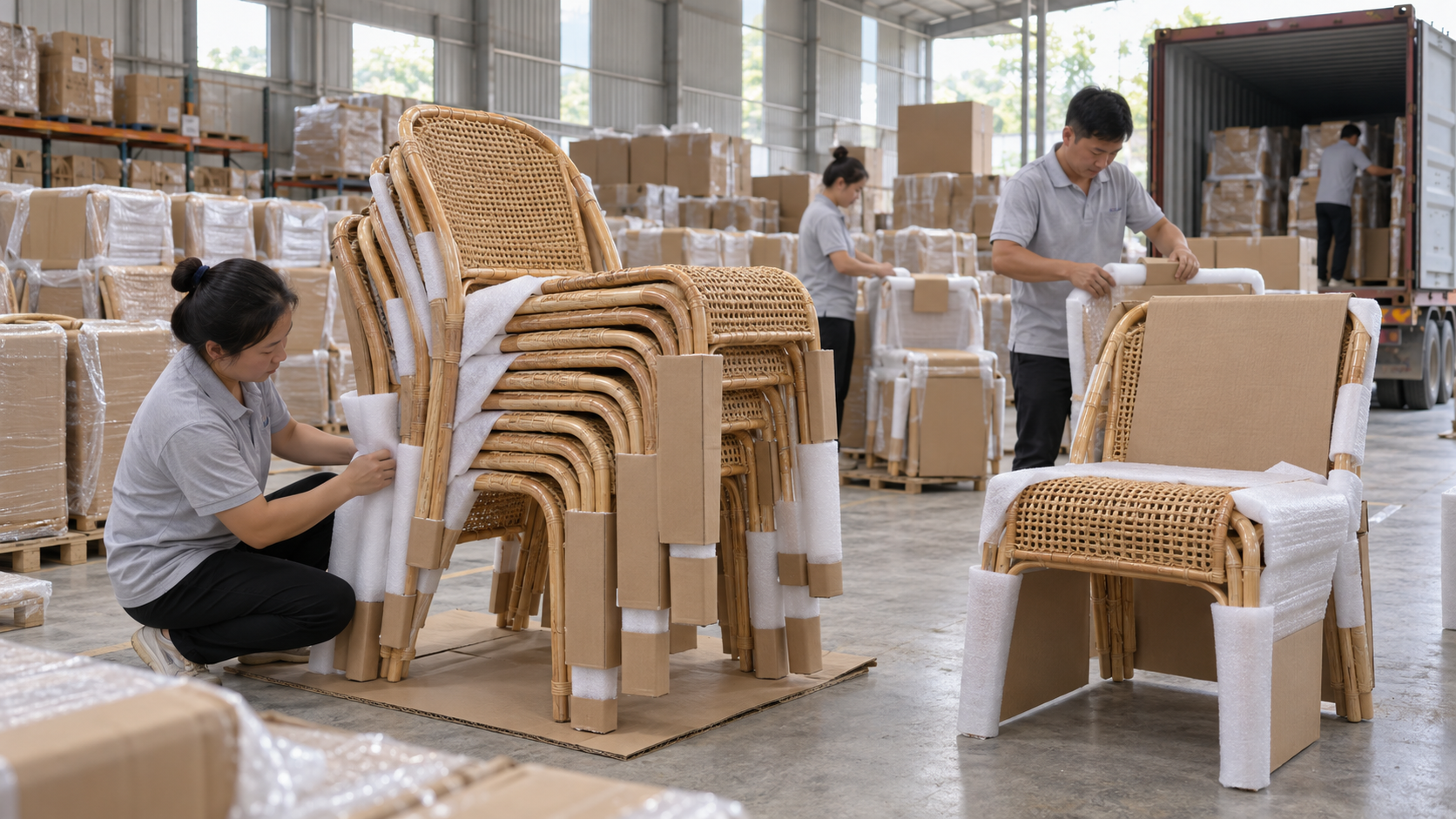
How furniture is packed for export affects container efficiency, freight cost allocation, and ultimately the landed cost per unit.
Lead Times
Handwoven furniture follows a different production rhythm from machine-made goods. As a general guide, our timelines look like this:
- Sampling: Two to four weeks for most standard constructions. Custom or technically complex designs may take longer. Sampling is often the first stage buyers try to compress, but it is usually the wrong place to cut time. Approving a piece from photographs and discovering after shipment that the proportions, weave tension, or finish are off is a very expensive way to save two weeks.
- Production: Six to ten weeks for standard bulk orders. Twelve weeks and longer for custom or complex collections. These timelines begin after sample approval and order confirmation.
- Ocean freight: Approximately three to four weeks from Ho Chi Minh City to the US West Coast, four to five weeks to the US East Coast, three to four weeks to major European ports, and two to three weeks to Australian east coast ports. Peak-season congestion can extend any of these.
For hospitality projects with a fixed opening date, work backward from the required delivery date and build in a schedule buffer. Handwork can be accelerated, but it is rarely inexpensive to do so.
Container Minimums
Our standard minimum order is a full 40-foot container. For smaller programs or initial orders, a 20-foot container may be possible on a case-by-case basis.
Container minimums are more practical than arbitrary unit counts because woven furniture varies so much in size and packing density. A 40-foot container might hold 300 dining chairs, 80 lounge chairs, or 40 daybeds. The minimum is driven by production and shipping efficiency, not by a number pulled from a rate card.
Starting at container scale also serves the buyer. It is large enough to validate the product, the production quality, and the logistics chain before committing to a multi-container program, while still being economical on a per-unit freight basis.
Container Efficiency
Woven furniture is often bulky relative to its weight, which makes container efficiency one of the biggest drivers of landed cost per unit. It is also one of the areas buyers most often overlook.
Knock-down construction, nesting, and carton dimensions can move landed cost more than another round of negotiation on the unit price. A supplier who wants to discuss packing before production starts is usually thinking about the total program cost rather than only the FOB price.
Container efficiency can move landed cost more than another round of price negotiation, yet it is rarely the first thing buyers discuss.
The packing conversation should happen during the design and sampling stage, not after production is complete. If a chair leg can be detached for flat-pack shipping and reattached on site, that changes both the carton dimensions and the number of units per container. Those are decisions that belong in the design brief, not in the warehouse.
Building a Landed Cost Model
A useful landed cost model comes down to a handful of inputs, and it is only as reliable as the weakest assumption in the set.
Classified unit cost
Pair the unit price with the confirmed tariff classification for that specific SKU. Do not rely on a broad category estimate or assume that a similar product from a previous season carries the same classification.
Every duty layer, shown separately
Show the MFN base rate, Section 301 (US), Section 232 where applicable (US), EVFTA preference (EU), or AANZFTA/CPTPP preference (AU) as separate lines. If everything is rolled into a single blended percentage, it becomes much harder to see what actually changed when a rate moves.
Freight allocated by real container fit
Divide ocean freight across the number of units that actually fit in the container, using packed dimensions rather than assembled dimensions. This is where good nesting or knock-down construction can materially improve the economics.
Fees, insurance, and inland transport
Include MPF and HMF (US), VAT (EU), or GST (AU), plus customs brokerage, marine insurance, and inland delivery from port to final destination. None of these is usually large on its own, but together they can undermine a margin assumption.
Build the model before committing to the order. Revisit it whenever policy changes, and for a program that spans several seasons, check tariff exposure at each reorder rather than treating it as something that was settled once at the beginning.

A landed cost model built before the order is placed prevents the invoice surprises that erode margins after the shipment arrives.
What We Handle and What We Do Not
We manufacture through our production network in Nha Trang, Ho Chi Minh City, Binh Duong, and Dong Nai. That gives us direct visibility into material and construction specifications, packing details, and realistic production timing. All of those are important inputs for classification and landed cost planning.
We quote FOB, prepare the export documentation, coordinate with the buyer's freight forwarder (or recommend one), and provide the product specifications and construction details that customs brokers need for accurate classification. Port congestion and equipment shortages have been recurring issues in recent years, so we build schedule buffer into production planning and recommend buyers do the same on the logistics side.
What we do not do is classify goods, file customs entries, or provide legal advice on duty liability. Those decisions belong with a licensed customs professional. Bring your broker into the conversation early, and we can make sure they have the documentation they need from the manufacturing side.
Buyers earlier in the sourcing process may find our guide to vetting a Vietnamese furniture manufacturer a useful starting point. Our guide to rattan and wicker manufacturing covers the material and construction detail that classification often turns on. For buyers evaluating how different production models work in practice, our OEM, private label, and custom manufacturing guide explains how each model operates through a Vietnamese manufacturer.
To see the full range of what we produce, visit What We Make, or get in touch to discuss a specific program.
Importing · Logistics · Landed Cost
Let's Price It Properly
Send us what you are looking to import and we will come back with detailed product specifications, construction and material information your broker can classify against, packing dimensions your forwarder can quote against, and a production timeline we can realistically support. No obligation and no pressure to place an order.
Start a Conversation