Restaurant seating works harder than almost any other piece of furniture in a hospitality program.
For restaurant groups, hotel food and beverage teams, and the designers who work with them, handwoven furniture brings a warmth that metal and molded seating rarely match. It also faces more daily stress than the same chair would in a lobby or guest room. Chairs are dragged across stone floors, wiped down between seatings, lifted onto tables at close, and used by a different guest several times a day.
This guide covers how to select and order handwoven rattan, bamboo, and all-weather synthetic fiber furniture for restaurants, bars, and hotel F&B outlets. It addresses the dimensions to lock in early, where woven seating wears first, the performance standards buyers commonly reference, and how to plan a restaurant program at container scale. Commercial terms for the request itself are covered in our hotel furniture RFQ guide.

What Makes Restaurant Furniture Different from Other Hospitality Furniture?
Restaurant furniture takes more cycles of use, movement, and cleaning than almost any other hospitality piece. Seats turn over several times a day. Chairs are pulled and pushed constantly. Surfaces are cleaned between seatings. Woven pieces for F&B need tighter dimensional control, protected wear points, sealed finishes, and confirmed structural testing.
A woven lounge chair in a hotel lobby and a woven dining chair in the hotel's restaurant can look like members of the same family. The dining chair is moved and loaded many times more often, usually by guests sitting forward to eat rather than reclining. Its construction has to reflect that.
Where Woven Furniture Works in F&B Spaces
Handwoven furniture fits most zones of a restaurant or hotel F&B outlet. The material is chosen by environment.
Dining rooms
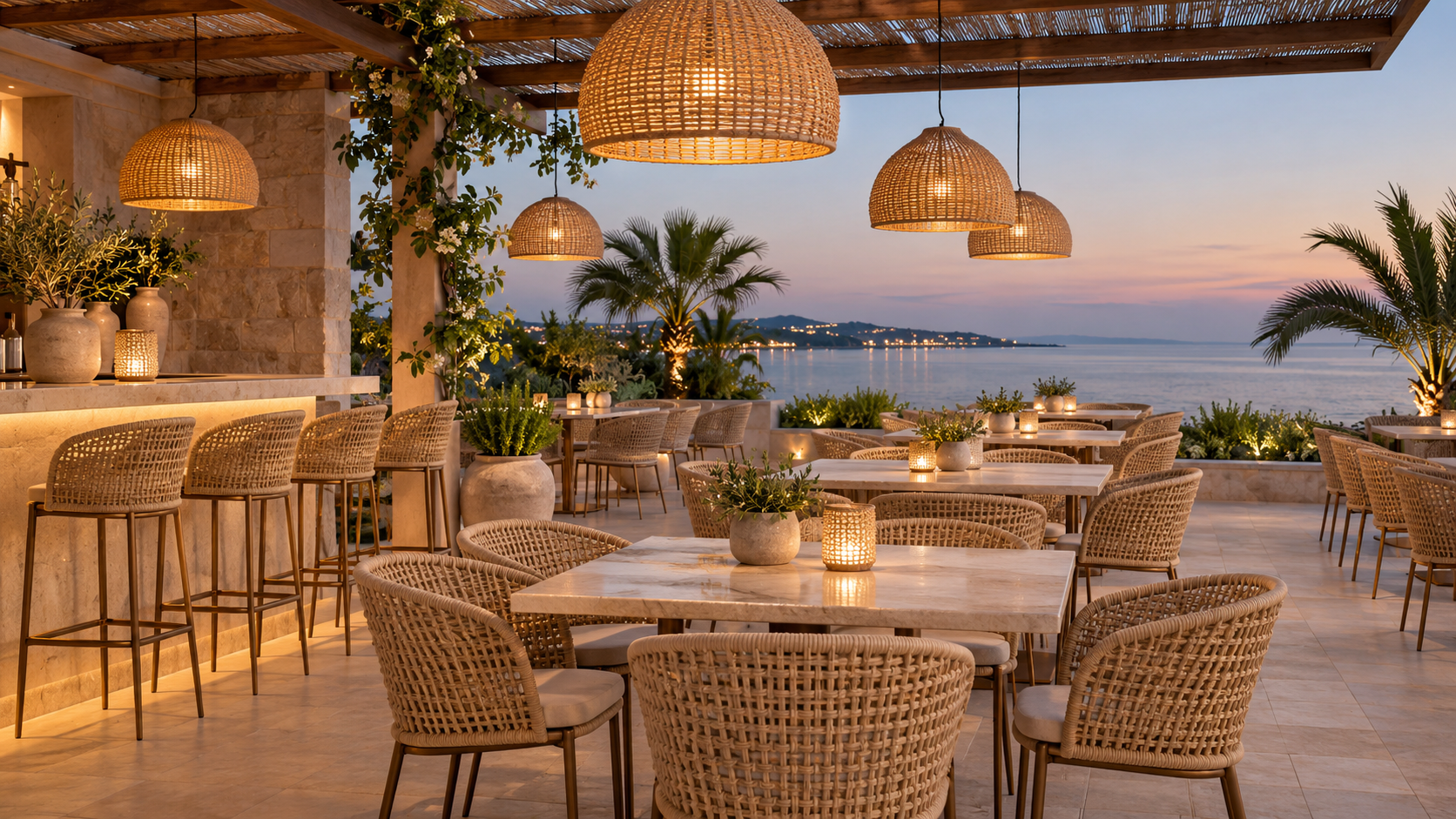
Rattan and cane dining chairs, woven-back chairs with upholstered seats, and tables with woven or bamboo bases. Natural rattan performs well in climate-controlled dining rooms.
Bars and counters
Bar and counter stools, woven bar front panels, and bamboo or rattan back-bar shelving.
Terraces, rooftops, and beach clubs
All-weather synthetic fiber on powder-coated aluminum frames, which tolerates sun, rain, and humidity far better than natural fiber. Our outdoor furniture guide covers frames, UV, and coastal exposure.
Lounges, lighting, and accessories
Lounge chairs, low tables, woven panels inset into upholstered banquettes, and pendant shades or screens that carry the weave through the room. See our guide to rattan and bamboo accessories.
For venues that sit between indoors and outdoors (covered terraces, open-sided dining rooms in tropical climates), the choice between natural and synthetic fiber is less obvious. Our comparison of synthetic fiber and natural rattan works through that decision by climate and use case.
Fix the Dimensions Before Anything Else
Seat and table heights decide whether a restaurant is comfortable. They are also expensive to correct after production. Designers usually work from these common ranges:
| Item | Typical seat height | Paired surface height |
|---|---|---|
| Dining chair | 17 to 18 in (43 to 46 cm) | Dining table, 29 to 30 in (74 to 76 cm) |
| Counter stool | 23 to 24 in (58 to 61 cm) | Counter, about 36 in (91 cm) |
| Bar stool | 29 to 30 in (74 to 76 cm) | Bar, about 42 in (107 cm) |
A clearance of roughly 10 to 12 inches between the seat and the underside of the table or bar top is a common working rule. Many planners also allow about 2 feet of bar length per stool.
Woven furniture adds a few details to those numbers:
- State the finished seat height, including any cushion, and say where it is measured. A woven seat with a loose cushion sits differently from a woven seat alone.
- Check arm height against the table apron if armchairs need to push in under the table. Chairs that cannot tuck in take floor space during service and block aisles.
- Confirm seat width and overall footprint against the floor plan. A chair that is two inches wider than drawn can remove a seat from every row of a long banquette run.
These belong in the design package before sampling starts. Our guide to briefing a manufacturer on design intent covers what that package should contain.
Where Woven Seating Wears First
Most restaurant chair failures happen at a handful of predictable points. Each one can be addressed in the design package rather than discovered in the first year of service.
The front seat rail
Every guest slides across it on the way into and out of the seat. Call for a dense, tightly wrapped binding at the front rail, and review it closely on the sample.
The leg ends
Chairs are dragged on stone, tile, and timber every service. Woven or wrapped leg bases fray quickly without a protected foot. Call for glides or caps suited to the floor finish, and confirm how they attach to rattan or bamboo.
The top back rail
Staff move chairs by the top rail, often lifting them by one hand. The back-to-frame joint needs to be built for that load as well as for a seated guest.
Strand ends and binding
Loose or poorly tucked ends catch clothing, stockings, and handbags. Ends should finish on the underside and be secured, an easy item to check at pre-shipment inspection.
Frame joints
Guests lean back on dining chairs, which puts racking loads on the joints between legs, seat, and back. Joinery, corner blocks, and frame material all affect how long a chair stays tight.
The finish
Natural rattan and bamboo need a sealed finish that tolerates frequent wiping. Synthetic fiber should be confirmed against the operator's cleaning routine. Test the finished sample with the venue's actual cleaning products before approving it.

Two operational questions also belong in the brief. First, whether chairs are lifted onto tables at close, since that affects leg finishing and table-top protection. Second, whether the venue needs stacking chairs for events. Most handwoven chairs do not stack, so venues that need flexible seating usually pair woven dining chairs with a separate event chair.
Standards Buyers Reference for Restaurant Seating
Requirements vary by country, jurisdiction, and operator brand standard. The following are the references most commonly written into restaurant seating requests.
ANSI/BIFMA X5.4 (Public and Lounge Seating). The 2020 revision expanded the standard's scope to include restaurant, dining, and cafeteria seating, as well as stools. It sets test methods and recommended minimum levels for safety, durability, and structural adequacy, and it is written for occupants up to 275 lb. Many hospitality brand standards and design teams ask for seating tested to it.
Upholstery flammability in the US. California's TB 117-2013, a smolder resistance standard for upholstered furniture, has been adopted as the national standard under 16 CFR 1640. California repealed the older open-flame TB 133 test in 2019. For woven seating, this applies to the upholstered parts: seat cushions, padded backs, and upholstered seats.
Contract seating in the UK. BS 7176 sets ignition resistance requirements for non-domestic upholstered seating across four hazard categories. Hotels and restaurants are typically placed in the medium hazard category.
Testing is carried out on a specific design and material combination, by a third-party laboratory. Timing matters. The required standard should be in the design package before sampling, while the frame, fill, and fabric can still be adjusted. The RFQ should also state who arranges and pays for testing. A requirement added after production approval usually means a new sample.
Name the standard in the brief.
A chair is tested as a finished design. Naming the required standard at the start lets the frame, the cushion, and the fabric be chosen to meet it, instead of being changed after the sample is approved.
Bars and Counters
Bar stools take a different kind of wear from dining chairs. Guests climb onto them, hook their feet on the footrest, and swivel or shift their weight on a small base.
- Footrests take constant scuffing. A metal kick plate or a wrapped and protected footrest lasts far longer than bare weave at that point.
- Base stability depends on the footprint at floor level, which needs to be balanced against how tightly stools are spaced along the bar.
- Counter and bar fronts in woven panels or bamboo are vulnerable at knee and shoe height. A solid plinth or kick strip at the base protects the weave.

Planning a Restaurant Program at Container Scale
Restaurant orders differ from hotel guest room orders in one important way: a single dining room often holds fewer pieces than a full production container. Programs reach container scale in a few common ways.
Restaurant groups rolling out a concept. One approved chair, stool, and table design produced for several locations at once, or in phased reorders. Once a design has been developed and sampled, later orders move faster and match the first. Our guide to custom furniture lead times explains why repeat orders skip most of the development and sampling time.
Hotels outfitting several F&B outlets. A dining room, a lobby bar, a pool bar, and a terrace, planned together with a shared design language and produced as one program.
Large venues combining indoor and outdoor seating. Natural rattan inside and all-weather synthetic fiber on the terrace, in coordinated designs, packed into the same shipment.
Seat counts come from the floor plan. Restaurant planners commonly allow about 12 to 15 square feet per seat for full-service dining and 18 to 20 square feet for fine dining. A 2,400 square foot dining room typically seats about 160 to 200 guests at full-service density. Our guide to importing furniture from Vietnam explains how mixed items are planned into a single container.
Spare units. Restaurant seating is replaced more often than most hospitality furniture, through breakage and wear. Ordering spare chairs and stools with the main production run, from the same material lot and finish batch, is far easier than matching a reorder years later. Our RFQ guide covers how to write attic stock into the request.
What to Include in a Restaurant Furniture RFQ
A restaurant seating request should give every manufacturer the same information, so quotes compare like for like:
- Item schedule by zone, with quantities for the dining room, bar, terrace, and any private dining rooms.
- Finished dimensions, including seat heights with cushions and the paired table and bar heights.
- Floor finishes, so leg protection can be chosen correctly.
- The cleaning routine and products the venue will use.
- Required standards and testing, with responsibility for arranging and paying for tests.
- Opening date, delivery point, and spare unit quantities.
Our hotel furniture RFQ guide covers the full request structure, including commercial terms, inspection, and a downloadable checklist that applies equally to restaurant programs.
Working with Pham Lifestyles
Pham Lifestyles produces handcrafted rattan, bamboo, and all-weather synthetic fiber furniture through established factory partnerships in Nha Trang, Ho Chi Minh City, Binh Duong, and Dong Nai, with direct production oversight and a commercial team in New York. For restaurant and F&B programs, we review dimensions, wear points, and finish requirements against the venue's actual use before sampling begins.
We work best with restaurant groups, hotel operators, and hospitality design firms planning F&B programs at container scale, whether that means a multi-location rollout, several outlets within one property, or a large venue with indoor and outdoor seating.
See What We Make for the categories we produce, or contact our team to discuss an upcoming restaurant or F&B program.
Seating for restaurants and bars
Start with the floor plan and the seat count
Share your drawings, seat counts by zone, floor finishes, and opening date. Our team will review the design package against the way your venue will actually be used, before the first sample is built.
Start a Conversation